Evitism™ Resources
The Foundations, Field Guides, And Tools That Make Coherence Practical Again
General Evitism™ Tools & Resources
How to Recognize, Name & Heal Avoidance in Everyday Life
Discover frameworks, practices, and reflection tools that help you see Evitism in yourself, relationships, and culture — and learn how to restore coherence one repair at a time.
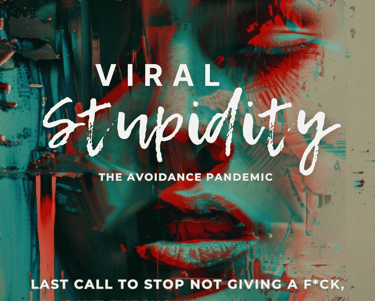
'Viral Stupidity' - The Avoidant Pandemic
The Field Book on Collapse, Avoidance & the Future of Coherence
The cultural diagnosis of our time. How normalized avoidance — the Evitism pandemic — spread across relationships, institutions, and the biosphere, and how Collective Neuro Theory offers the way back.
The Nervous System of Culture — A New Architecture of Coherence
An introduction to CNT, the framework that maps culture as a living nervous system. Learn how regulation, resonance, and repair scale from individual biology to collective intelligence.
Collective Neuro Theory™



Start Here
Whether you’re a clinician, therapist, educator,
parent, leader, creator, or simply human —
these resources help you see and understand the
hidden patterns driving modern disconnection.
Small repairs create large coherence.
Start where you are.
Frequently Asked Questions (FAQ)
Is Evitism the same as apathy or burnout?
No — though they’re related. Apathy is emotional numbness. Burnout is exhaustion.
Evitism is the mechanism underneath both: the learned avoidance pattern that protects us from overload in the short term but isolates us in the long run. It’s the reflex that says, “I’ll deal with this later” — on repeat, until later becomes never.
Why is Evitism increasing now?
Because modern culture is built on overstimulation without regulation. Digital platforms amplify outrage while rewarding disconnection. Institutions optimize for efficiency, not repair. Our nervous systems were never designed to metabolize this much input — so avoidance becomes adaptive. The problem isn't that people don't care; it's that caring now costs more energy than avoidance does. The discovery of the Collective Digital Unconscious™ (CDU™) reveals an even deeper mechanism: we've created an emergent field of digital unconscious processes that functions as a viral superspreader of avoidance patterns, accelerating their transmission beyond the limits of physical interaction. The CDU™ doesn't just connect individual nervous systems—it synchronizes and amplifies their dysregulation at unprecedented scale and speed.
How do I know if I’m being “evitistic”?
You’re not alone if you notice it in yourself — that’s the point.
Evitism looks like:
Ghosting instead of repairing.
Staying “neutral” to avoid conflict.
Labeling genuine discomfort as “not aligned.”
Confusing “boundaries” with walls.
Turning every feeling into content or optimization.
Whenever avoidance masquerades as clarity or peace — that’s Evitism at work.
What exactly is Evitism?
Evitism is the meta-pattern of systemic avoidance — the invisible pandemic of normalized reflexes that fragment relationships, institutions, and collective intelligence. It's not a moral failure but a regulation failure: when nervous systems are overloaded, avoidance becomes the default survival strategy. Operating primarily through the Collective Digital Unconscious™ (CDU™, further defined in the CNT architecture), these individual micro-escapes scale up to create systems that can no longer face truth, friction, or complexity.
What’s the connection between Evitism and attachment styles?
Attachment theory explains how individuals bond — or avoid bonding — based on early relational experiences. Evitism scales that same dynamic to the cultural level. Where an avoidant attachment style protects the individual from intimacy, Evitism protects entire societies from collective intimacy. It’s the same nervous system reflex — just multiplied.
That’s why modern culture feels both emotionally fluent and relationally fragile: we’ve globalized avoidance. Evitism is, in essence, attachment trauma gone systemic.
Can Evitism be healed or reversed?
Yes, but not through performance — through repair. Evitism can’t be solved by hacks or quick fixes. It dissolves when nervous systems relearn trust through small, repeatable acts of contact and truth-telling. That’s why Collective Neuro Theory™ focuses on reestablishing the loops of regulation → resonance → repair → integration. The antidote to avoidance isn’t effort. It’s coherence built through safety and contact.
How is Evitism connected to Collective Neuro Theory™ (CNT)?
CNT is the theoretical framework that explains why Evitism spreads and how it can be repaired. It treats culture as a living nervous system: when regulation breaks down, Evitism fills the gap. When those regulatory circuits are restored, coherence returns — in individuals, communities, and entire societies. Evitism.org focuses on naming and exposing the problem; CNT provides the architecture for systemic repair.
Is this just another “self-help” movement?
No — and that’s the point.
Evitism isn’t about personal optimization or 'becoming your best self'.It’s about recognizing the collective dysfunction that personalizes what’s actually systemic. This isn’t a wellness trend. It’s a cultural diagnosis. You can already feel it. Once you see it, you can’t unsee it.
Is Evitism the same as escapism?
No — escapism is a symptom; Evitism is the system. Escapism is what you do when you can't face something: binge Netflix, scroll endlessly, numb out with substances, lose yourself in fantasy. It's the temporary exit strategy. Evitism is why you can't come back. It's the underlying pattern that makes avoidance feel safer than engagement — not just once, but systematically. Escapism is the weekend bender. Evitism is the nervous system that can no longer tolerate sobriety. The key difference: escapism eventually ends. You finish the show, put down your phone, and sober up. Evitism doesn't let you return and repair what you avoided. It keeps you in the escape hatch, reframing your disappearance as 'self-care or 'protecting your peace.' Escapism is the flight response. Evitism is what happens when you never land.
Get in touch
Daniel Chris
hello at danielchris.com
Copyright © 2025-2026 by Daniel Chris, All Rights Reserved
Evitism™ — coined and first defined by Daniel Chris Oliveira (Oct/2025).
Rooted in Collective Neurosystemic Theory™ (CNT) — a framework for understanding civilization as a biological Collective Nervous System and the mechanisms of cultural coherence.